Hyderabad Is Growing Fast. But Do We Have Enough Water for the Future?
As Hyderabad expands, can better planning, smarter infrastructure, data and technology help strengthen the city's water future?
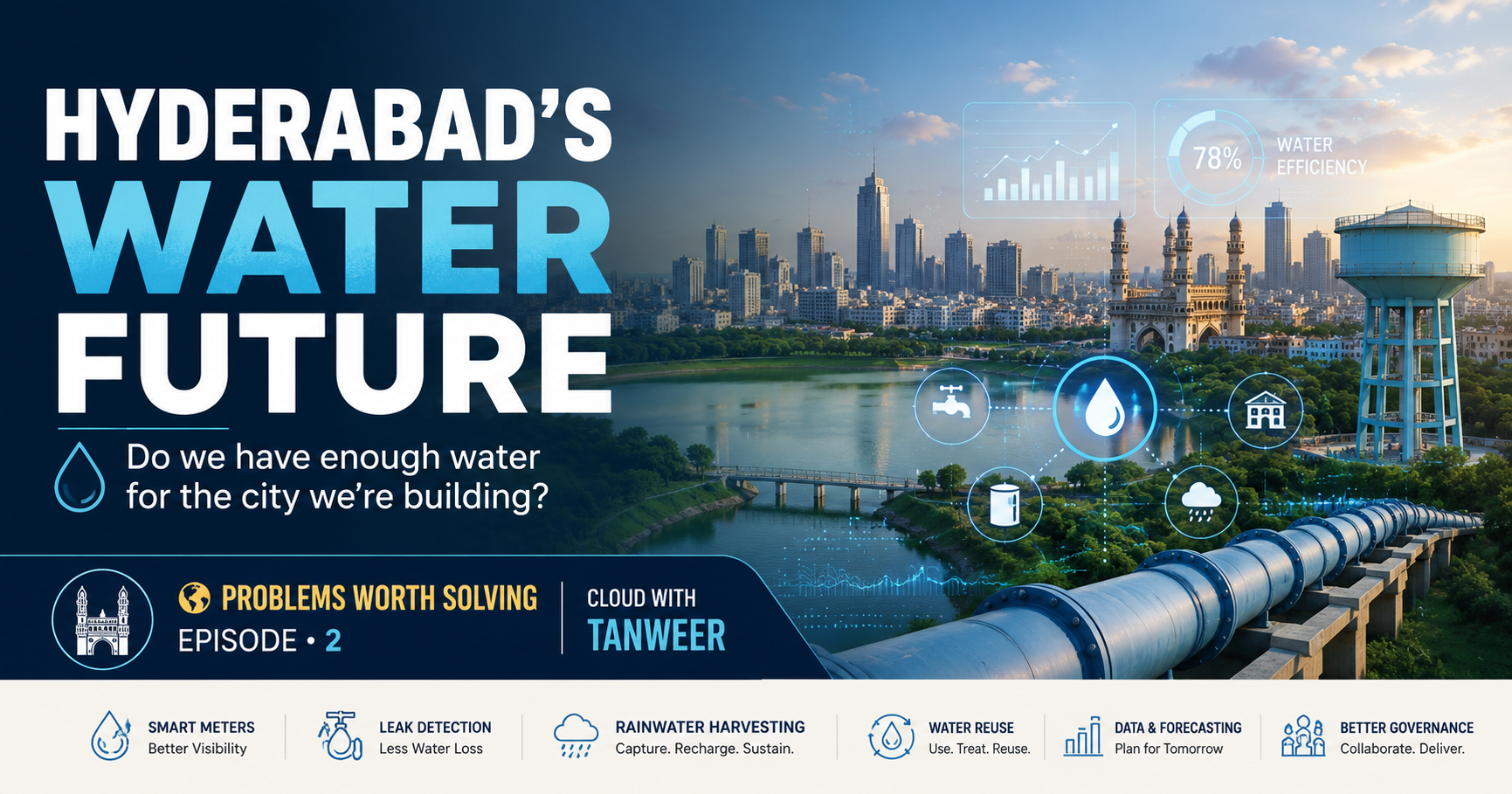
🌍 Problems Worth Solving • Episode #2
We Open the Tap. And Expect Water.
Every morning, millions of us do something without giving it much thought.
We open a tap.
And expect water to come out.
Behind that simple action is a huge system of water sources, treatment facilities, reservoirs, pumping stations, pipelines, groundwater, buildings and people.
Hyderabad is expanding rapidly.
New residential communities are being built.
New offices and technology campuses are opening.
Commercial areas are expanding.
The metropolitan region continues to grow.
That growth is exciting.
But it raises a fundamental question:
As Hyderabad builds for its future, are we planning its water infrastructure for the same future?
And there is another question that interests me as a technologist:
Can better data, monitoring, engineering and technology help us manage the water we already have more intelligently?
This article isn't an attempt to claim that technology alone can solve Hyderabad's water challenges.
It can't.
Instead, I want to explore how technology could become one additional layer in a much larger water strategy involving infrastructure, conservation, groundwater management, wastewater reuse, urban planning and citizen participation.
First, This Is Not About Saying Nothing Is Being Done
Before discussing solutions, it is important to recognize the work already happening.
Hyderabad already has major water infrastructure and conservation initiatives.
The Hyderabad Metropolitan Water Supply & Sewerage Board (HMWSSB) has promoted rainwater harvesting and groundwater conservation, including technical guidance for residential welfare associations.
Telangana is also investing in long-term water infrastructure.
The Government of Telangana has announced a major Godavari drinking-water project intended to bring additional water toward Hyderabad and Secunderabad while also supporting the filling of Osman Sagar and Himayat Sagar.
So the question isn't:
"Why isn't anybody doing anything?"
A better question is:
"What additional engineering and technology layers could complement the infrastructure and conservation work already underway?"
That is the perspective I want to explore.
Why Should We Care About Groundwater?
One data point deserves attention.
According to the Dynamic Ground Water Resources of Telangana State – 2024 assessment, Hyderabad district falls into the over-exploited groundwater category, with groundwater extraction exceeding its annual extractable resources.
That doesn't mean Hyderabad is suddenly going to run out of water.
But it does indicate pressure on an important resource.
And unlike a reservoir, groundwater is mostly invisible to citizens.
We don't see it declining beneath our feet.
Often, people recognize the problem only when:
- Borewell yields fall
- Borewells need to go deeper
- Tanker dependency increases
- Water availability becomes unreliable
That leads to an interesting engineering principle:
You can't manage what you can't adequately measure.
What if better measurement could become part of Hyderabad's long-term water strategy?
Think of Water as a System
As technology professionals, we work with large systems every day.
We monitor:
- Capacity
- Availability
- Performance
- Failures
- Demand
- Security
- Reliability
We don't simply deploy critical infrastructure and hope everything continues working.
Water infrastructure is obviously very different from cloud infrastructure.
But one principle applies to both:
Critical systems benefit from good observability.
At a simplified level, an urban water system looks like this:
Water Sources
      ↓
Treatment
      ↓
Storage
      ↓
Transmission
      ↓
Distribution
      ↓
Communities / Buildings
      ↓
Homes & Businesses
Now imagine adding another layer:
                 PHYSICAL WATER SYSTEM

Water Source → Treatment → Storage → Distribution → Consumers
                                  │
                                  ↓
                    MEASUREMENT & MONITORING

             Flow • Pressure • Level • Usage
                                  │
                                  ↓
                         SECURE DATA LAYER

                  IoT / Gateways / APIs
                                  │
                                  ↓
                       ANALYTICS PLATFORM

          Monitoring • GIS • Trends • Forecasting
                                  │
                                  ↓
                       OPERATIONS LAYER

          Alerts → Engineers → Field Teams → Action
The objective isn't to replace water engineers with software.
It is to give engineers better visibility into the physical system.
1. Could We Detect Water Loss Earlier?
Imagine a section of the distribution network receiving a certain amount of water.
If significantly less water can be accounted for downstream, something deserves investigation.
It could be:
- Leakage
- Metering differences
- Operational conditions
- Unauthorized consumption
- A faulty sensor
- Another network issue
The technology shouldn't automatically declare:
"There is a leak."
Instead, it could say:
"An unusual pattern has been detected in this zone. Please investigate."
For example:
Flow / Pressure Sensors
          ↓
Continuous Measurements
          ↓
Expected Pattern
      compared with
Actual Pattern
          ↓
Anomaly Detected
          ↓
Operations Alert
          ↓
Engineer / Field Inspection
The important part is not the AI model.
The important part is reducing the time between:
Something going wrong
and
Someone knowing about it.
2. Smart Metering Could Help Both Engineers and Citizens
Smart water meters could provide more granular information about consumption.
At an operational level, that data could help identify:
- Abnormal consumption
- Unusual demand patterns
- Potential building-level leakage
- Peak consumption periods
- Changes in neighbourhood demand
But there could also be value for citizens.
Imagine receiving a notification:
⚠️ Your household's water consumption is significantly higher than its normal pattern. Please check for a possible leak.
Or an apartment community seeing:
This Month

Water Received       → XXXXX litres
Water Consumed       → XXXXX litres
Treated Water Reused → XXXXX litres
Rainwater Captured   → XXXXX litres
Suddenly, conservation becomes visible.
3. Can We Forecast Demand Before It Becomes a Problem?
Hyderabad's water demand isn't static.
It changes with:
- Population
- New residential development
- Commercial expansion
- Weather
- Seasonal conditions
- Consumption behaviour
- Infrastructure expansion
Now imagine combining:
Historical Consumption
        +
Population Growth
        +
Building / Development Data
        +
Weather & Rainfall
        +
Seasonal Patterns
        ↓
Demand Forecasting
        ↓
Capacity Planning
This doesn't require some magical AI system.
Even good statistical forecasting and analytics can be valuable.
More advanced models could be introduced only where they demonstrate measurable improvement.
The objective should be simple:
Identify potential demand pressure before it becomes an operational crisis.
4. Groundwater Needs Visibility Too
Groundwater monitoring could be especially valuable because the resource itself is invisible.
Imagine combining information from:
Groundwater Monitoring Wells
            +
Rainfall
            +
Borewell / Extraction Information
            +
Geology
            +
Recharge Structures
            ↓
Groundwater Monitoring Platform
A GIS-based dashboard could then help visualize:
- Areas experiencing groundwater stress
- Seasonal changes
- Recharge patterns
- Long-term trends
- Areas requiring closer investigation
This wouldn't replace hydrogeologists.
Quite the opposite.
Technology should help groundwater experts see the system more clearly — not attempt to replace their expertise.
5. Hyderabad Already Promotes Rainwater Harvesting. Can We Measure Its Impact Better?
This is an area where we should build on existing work.
HMWSSB already promotes rainwater harvesting and groundwater conservation and provides technical guidance for constructing appropriate structures.
Methods include:
- Recharge pits
- Recharge trenches
- Recharge wells
- Rooftop rainwater harvesting
- Storage systems
That's important.
But there may be another interesting question:
Can we measure how effectively these systems are performing?
Imagine large apartment communities, technology campuses, malls, schools and government buildings having a simple water-conservation dashboard.
Rainfall
   ↓
Potential Rooftop Collection
   ↓
Actual Water Captured
   ↓
Water Stored / Recharged
   ↓
Monthly & Annual Impact
Now the conversation changes from:
"We installed a rainwater harvesting system."
to:
"Our system captured or recharged approximately X litres this year."
Measurement creates accountability.
It can also show which designs work best.
6. Treat Wastewater as a Resource Where Appropriate
Not every activity requires drinking-quality water.
Depending on treatment standards and applicable regulations, treated wastewater can potentially support suitable non-potable applications such as:
- Landscaping
- Construction
- Certain industrial processes
- Some cooling applications
- Other approved uses
Instead of thinking only:
Fresh Water → Use → Waste
a more circular approach is:
Fresh Water
     ↓
Consumption
     ↓
Wastewater
     ↓
Treatment
     ↓
Appropriate Reuse
Or simply:
Use → Treat → Reuse
A growing city shouldn't only ask how to bring in more fresh water.
It should also ask where safely treated water can reduce unnecessary demand for potable water.
7. Water Planning and Urban Planning Should Talk to Each Other
Imagine a major new residential or commercial development.
Thousands of people may eventually live or work there.
One of the earliest questions should be:
Where will the long-term water capacity come from?
Not just during the first year.
But after 5, 10 or 20 years.
Imagine planning systems being able to consider:
Existing Population
        +
Approved Developments
        +
Projected Population
        +
Existing Water Capacity
        +
Groundwater Conditions
        +
Wastewater Capacity
        ↓
Long-Term Infrastructure Planning
Urban growth and water infrastructure cannot be treated as completely separate conversations.
A Practical Idea: Start With One Smart Water Pilot
This is where I think the conversation becomes more interesting.
Instead of proposing a massive city-wide technology programme immediately, what if a small pilot was tested first?
For discussion, imagine selecting one suitable residential distribution zone.
The exact size and location should be decided by water engineers based on network characteristics and operational requirements.
Phase 1 — Establish the Baseline
Before installing new technology, measure what already exists.
Potential metrics could include:
| Metric | Why It Matters |
|---|---|
| Water entering the zone | Understand supply |
| Metered/estimated consumption | Understand demand |
| Pressure patterns | Identify network behaviour |
| Known leakage incidents | Establish baseline |
| Complaint volume | Understand citizen experience |
| Response time | Measure operations |
| Groundwater dependency | Understand alternative-source pressure |
| Tanker dependency | Understand supply reliability |
Phase 2 — Add Selected Monitoring
Depending on the area's needs:
Flow Sensors
     +
Pressure Sensors
     +
Selected Smart Meters
     +
Existing Operational Data
     +
GIS Information
          ↓
Secure Data Platform
Phase 3 — Build Operational Intelligence
The platform doesn't need to be complicated initially.
Start with:
Real-Time / Periodic Monitoring
              ↓
       Basic Analytics
              ↓
        GIS Dashboard
              ↓
      Threshold Alerts
              ↓
       Field Response
Only after enough good-quality data exists should more advanced anomaly detection or forecasting be considered.
What Could the Technical Architecture Look Like?
At a conceptual level:
┌─────────────────────────────────────┐
│          PHYSICAL WATER LAYER       │
│                                     │
│ Flow │ Pressure │ Level │ Metering  │
└──────────────────┬──────────────────┘
                   │
                   ↓
┌─────────────────────────────────────┐
│          EDGE / IoT LAYER           │
│                                     │
│ Device Gateway │ Local Processing   │
└──────────────────┬──────────────────┘
                   │
             Encrypted Data
                   │
                   ↓
┌─────────────────────────────────────┐
│            DATA PLATFORM            │
│                                     │
│ Ingestion                           │
│ Storage                             │
│ Data Quality                        │
│ Historical Data                     │
└──────────────────┬──────────────────┘
                   │
                   ↓
┌─────────────────────────────────────┐
│        ANALYTICS & INTELLIGENCE     │
│                                     │
│ Dashboards                          │
│ GIS Mapping                         │
│ Anomaly Detection                   │
│ Demand Forecasting                  │
└──────────────────┬──────────────────┘
                   │
                   ↓
┌─────────────────────────────────────┐
│          OPERATIONS LAYER           │
│                                     │
│ Alerts                              │
│ Engineers                           │
│ Field Teams                         │
│ Reports                             │
└─────────────────────────────────────┘
The implementation could use cloud, on-premises infrastructure or a hybrid architecture depending on government requirements, data classification, existing systems, cost and operational constraints.
The technology vendor is not the important part.
The architecture and measurable outcome are.
Security Must Be Designed From Day One
There is another side to making infrastructure smarter.
Cybersecurity.
Connected sensors, gateways, APIs and dashboards increase visibility.
But they can also increase the attack surface.
A smart-water architecture should therefore consider:
Device Identity
      ↓
Secure Communication
      ↓
Network Segmentation
      ↓
IAM / Role-Based Access
      ↓
Encryption
      ↓
Logging & Monitoring
      ↓
Incident Response
Other considerations include:
- Device lifecycle management
- Secure firmware updates
- Vulnerability management
- API security
- Least-privilege access
- Audit logging
- Data minimization
- Backup and recovery
- Resilience when connectivity fails
A water engineer shouldn't have to become a cybersecurity expert.
And a cybersecurity engineer shouldn't pretend to be a water engineer.
The solution comes from those disciplines working together.
How Would We Know Whether the Pilot Worked?
This is perhaps the most important part.
Don't measure success by saying:
"We deployed IoT."
or:
"We used AI."
Those are technologies.
They are not outcomes.
Instead, measure things such as:
Time to Detect Abnormal Conditions
                ↓
Time to Investigate
                ↓
Time to Repair
                ↓
Estimated Water Loss Reduction
                ↓
Complaint Reduction
                ↓
Supply Reliability
For rainwater harvesting:
Rainfall
   ↓
Water Captured
   ↓
Water Recharged / Reused
   ↓
Freshwater Demand Avoided
For groundwater:
Seasonal Groundwater Level
          ↓
Long-Term Trend
          ↓
Recharge / Extraction Relationship
If the pilot produces measurable improvement:
Improve it → Test again → Expand carefully.
If it doesn't:
Understand why → Change the approach → Test again.
That's engineering.
A Possible Pilot Roadmap
A pilot could conceptually follow something like:
Days 1–30: Understand
- Select appropriate pilot area
- Map existing infrastructure
- Identify available data
- Establish baseline metrics
- Define measurable objectives
- Complete security and privacy assessment
Days 31–60: Connect
- Integrate existing operational data
- Install selected monitoring devices where justified
- Configure secure data ingestion
- Create initial dashboards
- Define alert thresholds
Days 61–90: Measure
- Monitor patterns
- Investigate anomalies
- Record operational response
- Compare against baseline
- Identify data-quality issues
- Document lessons
At the end of the pilot, ask one simple question:
Did this improve water management enough to justify expanding it?
If yes, scale carefully.
If no, learn before spending more.
Technology Is Only One Part of the Solution
It is important to say this clearly.
AI cannot manufacture water.
IoT cannot replace reservoirs.
Cloud platforms cannot create rainfall.
Dashboards cannot recharge groundwater.
Technology cannot replace:
- Water infrastructure
- Reservoir management
- Pipeline maintenance
- Groundwater conservation
- Rainwater harvesting
- Wastewater treatment
- Responsible consumption
- Urban planning
- Government policy
- Skilled water engineers
Technology can provide something else:
Better visibility, faster detection, better forecasting and better information for decision-making.
And sometimes better information can significantly improve how infrastructure is operated.
This Needs Collaboration, Not Another Isolated App
I don't think Hyderabad needs another standalone mobile application claiming to "solve water."
A meaningful solution would require collaboration.
                 HMWSSB
                    +
        Urban Planning Authorities
                    +
      Ground Water Department
                    +
            Municipal Bodies
                    +
        Universities / Researchers
                    +
          Technology Industry
                    +
               Startups
                    +
          Resident Communities
                    ↓
        Better Water Management
Each group contributes something different.
Government understands policy, infrastructure and operational realities.
Water engineers understand the physical network.
Groundwater experts understand hydrogeology.
Researchers understand modelling and scientific evidence.
Technology professionals can contribute data platforms, cloud architecture, IoT, analytics, AI and cybersecurity.
Startups can experiment with new approaches.
Citizens experience the system every day.
No single group has every answer.
My Perspective
I'm approaching this question as a technology professional — not as a water engineer or policymaker.
My professional world involves concepts such as:
- Cloud architecture
- Security
- Monitoring
- Automation
- Capacity planning
- Reliability
- Data
- Resilience
Working with technology makes you think about systems.
And when I look at a challenge like urban water management, I naturally wonder:
Could some of those engineering principles contribute here too?
Not by replacing domain experts.
By working with them.
That's the purpose of this article.
Not to claim:
"Here is the solution."
But to ask:
"Here is one possible engineering approach. Is it worth exploring together?"
Hyderabad Is Already Building for Tomorrow
Hyderabad's growth is something worth celebrating.
But a world-class city isn't measured only by:
- Skyscrapers
- Technology campuses
- Flyovers
- Investments
- Data centres
- New companies
It is also measured by whether its people have reliable access to the fundamentals of everyday life.
Water.
Mobility.
Clean air.
Waste management.
Public infrastructure.
Technology can contribute to those problems.
But only when we begin with the problem rather than the technology.
A smart city isn't a city with more technology.
It's a city that uses technology, infrastructure and better information to improve people's everyday lives.
One Question for Hyderabad
Perhaps the question isn't only:
Where will Hyderabad get more water?
We should also ask:
How intelligently can we manage every litre we already have?
That includes:
Better infrastructure.
Groundwater conservation.
Rainwater harvesting.
Wastewater reuse.
Leak reduction.
Responsible consumption.
Better planning.
Better measurement.
And better decisions.
An Open Invitation
I'd genuinely like this article to become a conversation rather than simply another blog post.
If you work in:
- Water infrastructure
- HMWSSB or another government body
- Urban planning
- Groundwater management
- Civil engineering
- IoT
- Cloud architecture
- Data engineering
- Cybersecurity
- Academia
- Civic technology
- A residential community
I'd be interested in hearing what I have missed.
Would a small data-driven water-management pilot like this be useful?
What would you change?
What technical or operational challenges would make it difficult?
And most importantly:
What is one practical improvement that could make Hyderabad more water-secure over the next decade?
Let's discuss the problem.
And maybe build better solutions together.
🌍 Problems Worth Solving
Episode #1
🚦 Hyderabad Traffic Is Costing Us More Than Time. Can Technology Help?
Episode #2
💧 Hyderabad Is Growing Fast. But Do We Have Enough Water for the Future?
Coming Next
🌧️ Why Do Our Cities Still Flood After Heavy Rain?
Sources & Further Reading
Central Ground Water Board (CGWB)
Dynamic Ground Water Resources of Telangana State – 2024
Official assessment covering groundwater recharge, extraction and categorisation across Telangana.
Hyderabad Metropolitan Water Supply & Sewerage Board / Government of Telangana
Rain Water Harvesting & Conservation
Information about HMWSSB's rainwater-harvesting programme, groundwater recharge methods and technical guidance.
Ground Water Department, Government of Telangana
Official groundwater monitoring, assessment, hydrogeological and water-quality information.
Government of Telangana
Official information and announcements concerning Hyderabad's drinking-water infrastructure and long-term Godavari water projects.
The architecture and pilot described in this article are conceptual proposals intended to encourage technical discussion. They are not representations of HMWSSB's existing internal architecture or an assessment of systems currently deployed by any government department.
Problems Worth Solving is a Cloud with Tanweer series exploring real-world challenges through engineering, technology, data and practical problem-solving.
Cloud with Tanweer
About the author
- Hi, I'm Tanweer Ahmed 👋 I'm a Cloud Security Engineer with 7+ years of experience working across AWS, Microsoft Azure, and Google Cloud. Through Cloud with Tanweer, I write about cloud architecture, security, Infrastructure as Code, DevSecOps, AI, and the technologies shaping modern enterprise infrastructure. I focus on practical engineering perspectives — not just how technologies work, but how they should be designed, secured, governed, and used to solve real-world problems. What I write about: ☁️ Cloud Architecture & Multi-Cloud 🛡️ Cloud Security & Governance ⚙️ Terraform & Infrastructure as Code 🔐 IAM & Zero Trust 🚀 DevSecOps & Automation 🤖 AI + Cloud Engineering 🏙️ Technology & real-world engineering problems I'm currently publishing the Future of Cloud Series, exploring how cloud, security, automation, and AI are changing the role of modern cloud engineers and architects. 🌐 Portfolio: tanweerahmed.in 💼 LinkedIn: linkedin.com/in/shaik-tanweer-ahmed 💻 GitHub: github.com/shaiktanweer5
Comments
Join the discussionNo comments yet. Be the first to comment.